Every day, mobile devices gain more ground in the online market. Over 50% of online purchases in Spain are already made on mobile devices, and Mobile First, which sounded like an aspiration in recent years, has now become a “must” in our digital strategy.
In the TLG Commerce digital marketing department, we analyzed several mobile versions of online stores to see what users look for when they access our eCommerce from their smartphone.

In short, there are concepts every eCommerce needs: usability, navigation and smooth interaction for the user.
User behavior on mobile devices
Traditional persuasion techniques don’t work because mobile purchases tend to be more impulsive. In fact, mobile browsing on the same site can drop to as little as a third per session compared with desktop sessions.
That’s why mobile users will be happier if:
1. We give them a web template that’s easy to navigate.
2. We add an intuitive navigation system.
3. We build a lightweight mobile website.
All these points share the same goal: reducing the site’s load time and offering users a comfortable, pleasant and fast shopping experience.
Digital users interact with their smartphone up to 200 times a day on average, and they hate waiting, especially on mobile… over 75% of the mobile traffic reaching your eCommerce will leave the page if it takes more than 5 seconds to load!

Today, mobile web pages weigh 2MB on average, whereas in 2011 they were only 390KB!
We must keep this in mind when we talk about load speed and how it relates to user experience. We always consider the moment when the user can start interacting with the web page, even if some first-party or third-party elements haven’t loaded yet.
Why has their size grown more than sixfold?
The content we offer is ever richer, more elaborate and more personalized. Let’s not forget that in 2015 video became the main source of content on social media, and its consumption has accelerated thanks to how easy it is to share and use.
Online businesses have also adopted video to support the purchase decision process, besides increasing time per session and leading to better rankings for mobile versions.
All these results lead to the same place: conversion.
What conversion looks like on mobile devices
Every touchpoint must influence the user’s final decision, because user conversion and interaction go hand in hand with mobile load speed.
Longer load times cause a lot of damage, including:
1. Poorer page performance.
2. Higher bounce rate.
3. Lower conversion rates.
4. Lower retention rates.
5. It ends up affecting page crawling.
Your page speed directly affects the number of URLs Googlebot manages to crawl. The slower your mobile site loads, the fewer chances you have of deeper crawling and efficient indexing of your URLs.
According to a SOASTA study on conversion versus load time on mobile websites, the ideal load time would be around 2.4 seconds.

Source: SOASTA Case Study
On the other hand, improving your online store’s load time will help you get lower bounce rates and higher-quality visits.
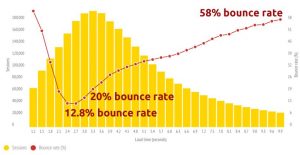
Source: SOASTA Case Study
What happens when you combine conversion and user experience?
Combining them lets you open the door to new business opportunities and to budget you can invest in improving your customers’ conversion rates.
In fact, this is one of the current trends in strategic digital marketing.
In short, you’ll get more out of the traffic from your potential customers, making them more likely to convert into a sale on their first visit. That’s why I talk about optimization as the metric that ends up increasing the return on our investments while it converts a higher share of our current traffic and attracts new users at a lower cost.

Combined, these two metrics produce a key performance indicator for our eCommerce called CPA (Cost per Acquisition), in other words: how much do I pay for each customer who ends up buying?
This indicator is the holy grail for companies that need to advertise online: if my CPA goes down, I can invest more in promoting my company in other media, online or offline, while building a more robust business structure.
General conclusions
However small and insignificant the changes to a “landing page” designed specifically for mobile devices may be, we can improve visit conversion by up to 200% just by improving the design of a single button.
It’s vital that users can move around our eCommerce with a single finger and, if possible, complete checkout in a single step.
Above all, you need to bear in mind the latency and bandwidth of a mobile connection: 1.5MB/s on 3G, 4MB/s on 4G, while our home connection would reach 200MB/s.
As a result, we find utopian and exasperating load times; optimizing the website’s size is a key factor in lowering your CPA.
With that reduction you’ll be able to invest more and strengthen your ROI, which will undoubtedly translate into profits for your eCommerce.