ChatGPT is starting to move into territory eCommerce businesses know very well: product catalogs, purchase intent and feed-based advertising. OpenAI has launched in beta campaigns built from product feeds within ChatGPT Ads, a feature that lets retail advertisers upload full catalogs and generate ads at scale from that data. Marketing4eCommerce reported the news on June 12, 2026, highlighting that advertisers will be able to work with feeds of up to 2 million items.
For brands, the takeaway shouldn’t be purely about advertising. This move confirms something deeper: the product catalog is becoming central to appearing, competing and converting in conversational environments. At Trilogi, we see it as a natural evolution of eCommerce SEO, paid media and GEO (Generative Engine Optimization), because data quality will matter more and more for an AI to understand what you sell, when to show it and why it should be relevant to a search or conversation.
What are product feed ads in ChatGPT?
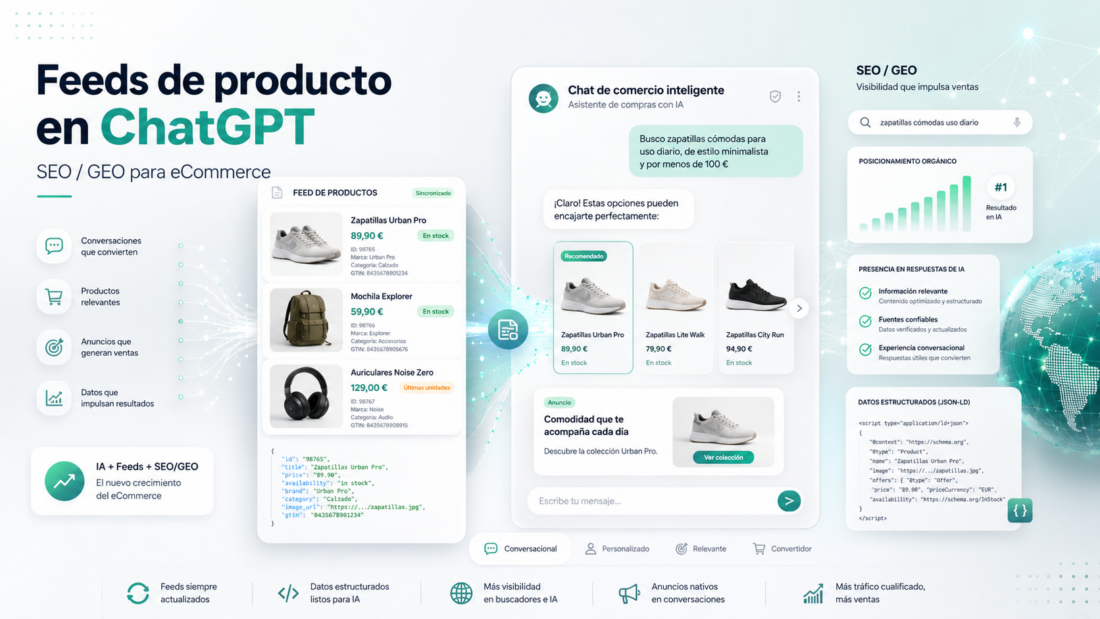
Product feed campaigns let retail advertisers upload a feed to Ads Manager and create ads from that catalog. According to OpenAI’s documentation, they’re designed especially for retailers with large or frequently changing catalogs, because they make it easier to create campaigns at scale, connect relevant products with high-intent conversations and keep details such as price, availability and metadata up to date.
The difference from a traditional ad is clear: instead of manually creating each ad, the eCommerce business feeds OpenAI structured data. From there, Ads Manager can select products, apply filters by ad group and generate ads whose title and description come straight from the feed. This makes catalog quality a critical factor: if your titles, descriptions, images, URLs, prices or stock data aren’t well crafted, ad performance will suffer too.
There’s an important caveat: during this beta, OpenAI clarifies that feed products are only eligible for ads and won’t appear in organic ChatGPT conversations, although the company says it may offer that capability in the future.
Why it matters for an eCommerce business
Until now, many marketing teams have treated feeds as an operational requirement for Google Merchant Center, Meta Ads, marketplaces or comparison sites. With ChatGPT Ads, the feed enters a different context: a conversation where the user doesn’t always search for an exact keyword but describes a need.
For example:
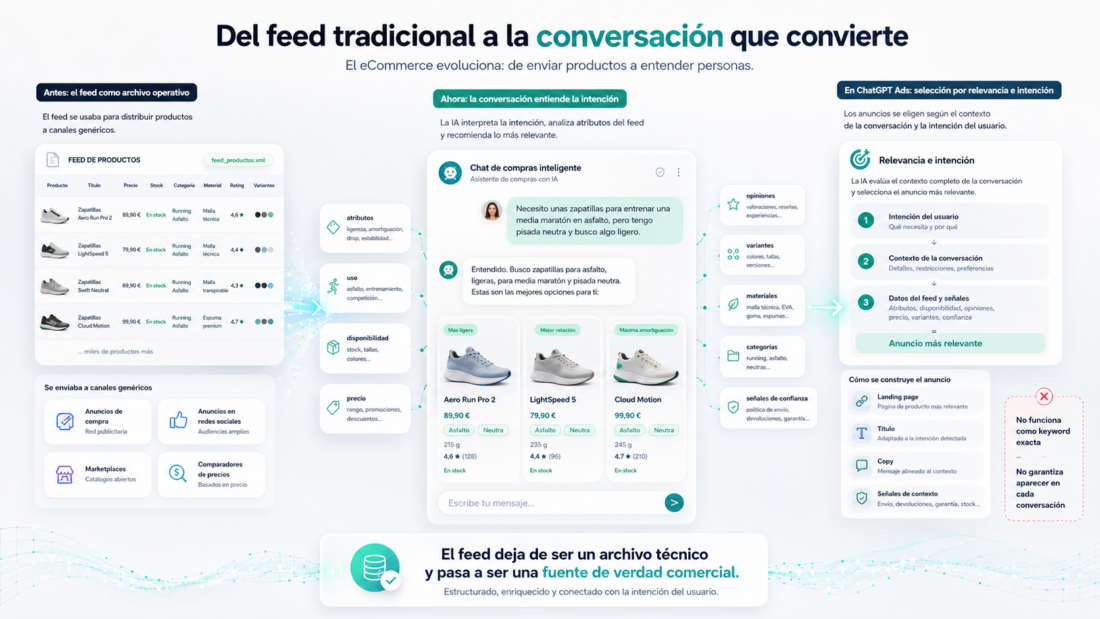
“I need running shoes to train for a half marathon on asphalt, but I have a neutral stride and I’m looking for something lightweight.”
In a search like this, the AI doesn’t just need a product. It needs to understand attributes, use, availability, price, reviews, variants, materials, categories and trust signals. That’s why the feed stops being a simple technical file and becomes a commercial source of truth.
OpenAI explains that ad selection is mainly based on relevance to the conversation’s context and intent, taking into account inputs such as the landing page, title, copy and context signals configured in the ad group. These signals don’t work as exact keywords and don’t guarantee appearing in specific conversations.
Current status and availability
As of June 15, 2026, ChatGPT Ads is still in beta. OpenAI states that Ads Manager Beta is available to advertisers in the United States, Australia, New Zealand and Canada, and that it plans to expand to the United Kingdom soon. Availability may vary by country and region.
Meanwhile, ads in ChatGPT have rolled out to users in the United States, the United Kingdom, Australia, New Zealand and Canada, and may appear on the Free and Go plans. OpenAI also clarifies that ads are kept separate from ChatGPT’s answers, are labeled as sponsored and don’t influence the model’s responses.
For a Spanish or European eCommerce business, this doesn’t mean “wait.” It means get ready. The advantage will go to those who arrive with a clean, automated and optimized catalog when the channel becomes available or when new conversational commerce integrations open up.
Platforms such as LogiCommerce, Shopify and PrestaShop, which we work with at Trilogi, are already prepared for this new scenario.
Product feed requirements for OpenAI
OpenAI points to a technical specification for structuring the feed. The goal is for ChatGPT to be able to index and display products with up-to-date price and availability, based on defined fields, data types, constraints and validation rules.
General delivery requirements
| Area | Requirement | What it means for your eCommerce |
|---|---|---|
| Feed model | Full snapshot feed: a complete catalog export as the source of truth | It’s best to automate a full export from the eCommerce platform, ERP, PIM or middleware |
| Frequency | OpenAI recommends updating at least daily | Stock, price and promotions must be synced frequently |
| Delivery | Upload via SFTP | A secure technical connection and a recurring process need to be set up |
| Formats | Preferably Parquet; also jsonl.gz, csv.gz and tsv.gz | The technical team should choose a maintainable, scalable format |
| Encoding | UTF-8 | Avoids errors with special characters, languages and symbols |
| File name | Stable name; the previous snapshot must be overwritten | Avoid generating different names with each update |
| Shards | Recommended up to 500,000 items per shard and files under about 500 MB | Large catalogs must be split in a stable way |
| Validation | Start with a sample of about 100 products, validate required fields and run QA before the first full snapshot | Reduces errors before launching the full catalog |
These requirements come from OpenAI’s official guide to file-based feed delivery, which also warns of common errors such as missing required fields, outdated field names or badly formatted values.
Minimum and maximum feed size
For feed-based campaigns, OpenAI requires the feed to contain a minimum of 1,000 products and a maximum of 2 million products.
This rules out very small catalogs, but opens a clear opportunity for mid-sized and large retailers, vertical marketplaces, DTC brands with many variants, fashion, home décor, electronics, sports, specialty food or B2B businesses with broad assortments.
Main required fields
The OpenAI feed includes required and optional fields. Key required or critical fields include:
| Block | Key fields |
|---|---|
| OpenAI flags | is_eligible_search, is_eligible_checkout; is_eligible_ads is optional for controlling ad eligibility |
| Basic data | item_id, title, description, url |
| Product information | brand |
| Media | image_url |
| Price | price, with ISO 4217 currency code |
| Availability | availability, with values such as in_stock, out_of_stock, pre_order, backorder or unknown |
| Seller | seller_name, seller_url |
| Returns | return_policy |
| Geotargeting | target_countries, store_country |
| Conditional | availability_date if the product is on pre-order; seller_privacy_policy and seller_tos if checkout is enabled |
The specification also defines relevant constraints: item_id must be stable and unique per variant; title has a maximum of 150 characters and should avoid excessive capitalization; description allows up to 5,000 characters of plain text; the URL must resolve correctly; the main image must be JPEG or PNG; and countries must use ISO 3166-1 alpha-2 codes.
Optional fields that can make a difference
Beyond the required minimum, some fields can boost relevance and trust:
product_category, to classify the product better.material, dimensions, weight and physical attributes.additional_image_urls, video or 3D model.sale_price, promotion dates and unit pricing.- Variant data such as
group_id,variant_dict, size, color or gender. shipping, shipping methods and delivery times.review_count,star_rating, reviews and FAQs.related_product_idandrelationship_type, useful for cross-selling, accessories or substitutes.geo_priceandgeo_availability, for prices or stock by region.
OpenAI includes these blocks in the product schema to improve availability, seller context, returns, performance signals, compliance, reviews, related products and geographic data.
How to create a campaign from a feed
OpenAI’s official workflow consists of several steps:
- Create a product feed from the Tools > Feeds tab in Ads Manager.
- Set up the SFTP connection with a password or SSH key.
- Upload and validate the feed.
- Create a campaign and select the Product feed type.
- Create an ad group, select the feed and apply product filters.
- Create an ad template.
- Review the feed, product count, titles, descriptions, images, landing pages, budget, bid and targeting before submitting the campaign for review.
OpenAI notes that feed processing can take anywhere from a few minutes to several hours depending on size, and that products are processed gradually. It also recommends using the ads_metadata field when standard filters aren’t enough, for example to group products by bidding_tier or product_line.
What an eCommerce business should audit before moving into ChatGPT Ads
Activating product feeds in ChatGPT shouldn’t be approached as “let’s upload a CSV and see.” To do it right, it’s worth reviewing five layers.
1. Catalog quality
Titles must be clear, distinctive and useful. “Shoe model X” isn’t enough. In a conversational environment, it may be more useful to include product type, use, gender, color, material or main attribute, without resorting to keyword stuffing.
Descriptions should explain benefits, use cases, compatibility, materials, measurements and common questions. If the AI needs to understand when to recommend a product, the description must address intent, not just list features.
2. Data architecture
The feed must come from a reliable source: eCommerce platform, ERP, PIM, DAM or middleware. If each channel has different data, inconsistencies in price, stock, variants or images will appear.
This is where an agency like Trilogi adds value: it’s not just about marketing, but about integrating catalog, business, technology and measurement. That’s how we define ourselves: as an eCommerce agency and digital consultancy, with strategy, marketing, technology, design and AI services focused on digital growth.
3. Product SEO and GEO
The ChatGPT Ads feed is also an opportunity to review how an AI understands your catalog. In GEO, the question isn’t just “does this URL rank?” but “can an AI identify this product as the right answer to a specific need?”
Trilogi already works on GEO and AEO as an evolution of SEO for online stores, optimizing content for AI-powered search engines, generative answers and conversational experiences.
4. Landing pages and post-click experience
OpenAI can send traffic to the product page. If the landing page is slow, doesn’t show the same price as the feed, displays an out-of-stock variant or doesn’t match the user’s intent, the problem won’t be the channel: it will be the experience.
A competitive feed must be backed by solid PDPs: quality images, clear variants, delivery details, visible returns, reviews, FAQs, real availability and frictionless calls to action.
5. Measurement and profitability
ChatGPT Ads shouldn’t be analyzed in isolation. OpenAI states that Ads Manager Beta provides metrics such as impressions, clicks, spend, CTR, average CPC, average CPM and conversions. It also lets you use UTM parameters on landing pages to analyze traffic in external tools.
The key will be linking campaigns with margin, stock, repeat purchases, LTV, return rate and commercial priority. Not every product in the catalog should carry the same weight.
Checklist to prepare your product feed
Before launching or adapting your feed for ChatGPT Ads, check:
- Does the catalog have at least 1,000 eligible products?
- Does each variant have a unique, stable
item_id? - Are titles descriptive, readable and free of excessive capitalization?
- Are descriptions in plain text and do they explain real uses?
- Do product URLs resolve correctly and use HTTPS?
- Is the main image high quality, accessible and consistent with the product?
- Are price, currency, stock and promotions up to date?
- Are variants grouped correctly?
- Are there shipping, returns and seller details?
- Are there reviews, ratings or FAQs that can build trust?
- Can rules be created by margin, season, category or priority?
- Can the feed be updated daily and reliably?
- Are landing pages consistent with the feed?
- Are UTMs and conversion events set up?
ChatGPT Ads and GEO: an opportunity beyond paid media
Although OpenAI clarifies that feed products in this beta don’t appear in organic conversations, the direction is clear: conversational engines need structured, reliable and up-to-date data to connect users with products.
That’s why preparing the feed isn’t just a paid media task. It’s an investment in catalog architecture, technical SEO, product content and visibility in generative engines. eCommerce businesses that already have complete product pages, clean taxonomies, reliable stock data, well-modeled attributes and useful content will be better positioned for however the channel evolves.
At Trilogi, we combine eCommerce SEO, GEO, data strategy, eCommerce technology and traffic acquisition so your catalog isn’t just a database but a growth asset. Our eCommerce SEO approach focuses on searches with a direct impact on sales, technical audits, migrations, rich snippets, category architecture, content and conversion.
Conclusion: the feed will be the new conversational shop window
Product feed ads in ChatGPT are a clear sign of where digital commerce is heading. Users no longer just search on Google, filter on marketplaces or compare on social media. They also talk to AI assistants to discover, compare and decide.
To compete in this environment, eCommerce businesses need much more than campaigns. They need clean data, useful content, robust feeds, reliable measurement and a strategy that connects SEO, GEO, paid media and technology.
The question isn’t whether your brand should prepare its catalog for ChatGPT Ads. The question is whether your catalog is ready for an AI to understand it, compare it and select it when the user is ready to buy.
Want to prepare your eCommerce for the new generation of conversational search and ads? At Trilogi, we help you audit your catalog, optimize your feed, improve your product pages and design a sales-focused SEO/GEO strategy.
Frequently asked questions about feeds for ChatGPT ads
They’re ChatGPT Ads campaigns that let retail advertisers upload a product feed and create ads from the catalog. They’re designed for eCommerce businesses with large or frequently changing catalogs and for showing relevant products in conversations with purchase intent.
OpenAI states that feeds must contain a minimum of 1,000 products and a maximum of 2 million products.
Not during the beta. OpenAI clarifies that feed products will only be eligible for ads and won’t appear in organic conversations, although it may offer that capability in the future.
OpenAI recommends a full snapshot feed delivered via SFTP and updated at least daily. The preferred format is Parquet, although jsonl.gz, csv.gz and tsv.gz are also accepted, with UTF-8 encoding.
Key fields include item_id, title, description, url, brand, image_url, price, availability, seller_name, seller_url, return_policy, target_countries and store_country, plus flags such as is_eligible_search and is_eligible_checkout.
Yes. Although ad availability is still limited by country, preparing the feed improves catalog quality, strengthens SEO/GEO, organizes product data and gets you to new conversational commerce channels sooner when they open. OpenAI states that Ads Manager Beta is evolving and that availability may expand over time.