Artificial intelligence has established itself as one of the essential drivers of digital transformation. However, while many companies continue to experiment with isolated use cases, others are already building complete infrastructures that multiply their ability to generate and close business. At Trilogi, we see a clear pattern: organizations that integrate AI into their Go-To-Market (GTM) processes are gaining a huge competitive advantage.
GTM Engineering isn't a fad: it's a response to a real problem. Companies that adopt it are generating more opportunities with small teams than others with dozens of SDRs. The difference isn't in working harder, but in building smarter, more scalable, and more efficient systems.
The challenge is no longer technological; the tools already exist. The real challenge is implementing them and transforming the commercial culture, changing mindsets, and building teams that not only sell but also design their own growth. And that evolution does not happen on its own: it requires a business consulting firm like ours to accompany, guide, and execute the transformation at the speed demanded by the market.
In this article, we analyze how this discipline works, what skills it allows you to develop, and why its impact is already visible in all sectors.
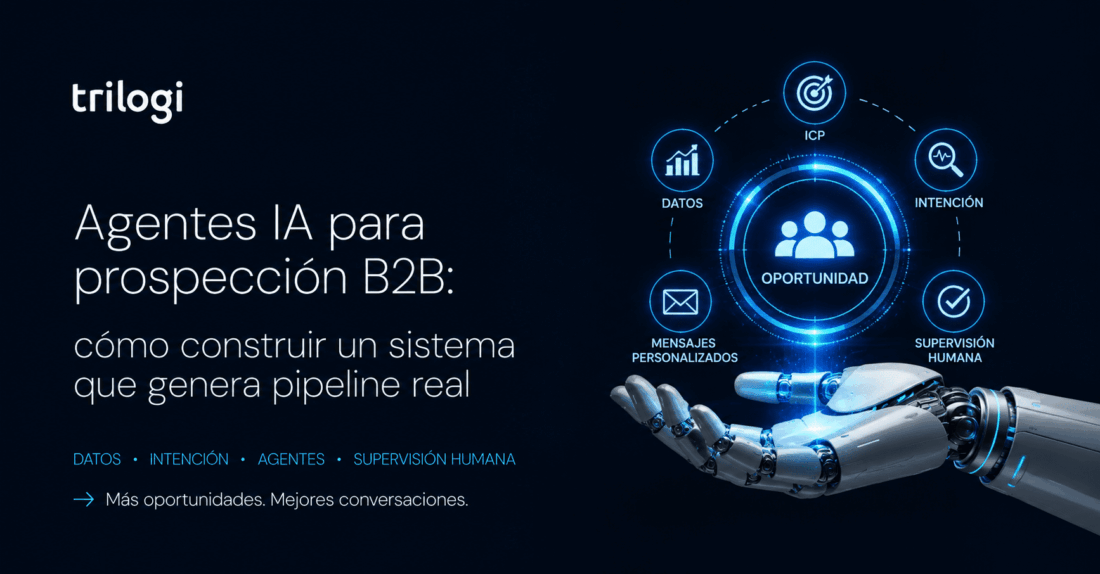
One of the most effective ways to apply GTM Engineering to sales lead generation is through AI agents capable of identifying opportunities, initiating conversations, and accelerating the pipeline: find out how they work in our video on AI agents for sales lead generation.
What is GTM Engineering and how can it help you scale your business?
In the field of Growth, Sales, and Marketing, the term GTM (Go-to-Market) is used to describe the set of strategies that a company employs to enter a market or attract new customers. A classic example in B2B would be a cold email campaign with AI agents targeting potential buyers.
But the concept changes radically when we add the word "engineering."
GTM Engineering combines market penetration strategies (Go-to-Market) with the technical and structured implementation of tools, processes, and automations that support and maximize those strategies. It is, in essence, the transformation of your sales funnel into an intelligent, scalable, and efficient machine.
It involves leveraging technology to enhance every stage of the sales cycle: from lead generation, through qualification and conversion, to customer retention and expansion.
The goal is to design an infrastructure that reduces manual tasks, improves personalization, accelerates decision-making, and generates sustained growth.
What GTM Engineering teams really build
The most advanced companies are automating processes that previously required hours of human labor. Today, thanks to AI and data integration, it is possible to design a GTM system that operates practically on autopilot. Among the most common use cases are the following.
Automatic generation of commercial content
By combining data from CRM, product usage platforms, and call recordings, AI can generate:
- Fully automated kickoff presentations.
- Business reports based on real data.
- Consistent business documents ready to be delivered to the customer.
This allows the team to focus on strategy rather than on the operational preparation of materials.
Automation of commercial follow-up
After each call, the AI analyzes the conversation, identifies the customer's intent, key points, and needs, and automatically generates personalized follow-up emails.
For many companies, this part of the process is already significantly optimized.
Workflows based on intent signals
AI allows you to detect customer behavior in real time and trigger automatic actions, such as internal alerts, personalized sequences, or CRM updates.
The goal is to act at the most relevant moment to maximize conversion.
Operational automation of the pipeline
Processes such as lead assignment, segmentation, data enrichment, and territory management can be executed automatically.
This frees up resources and prevents operational bottlenecks.
AI applied to complex materials
The next step is to generate advanced commercial materials, such as:
- Complete proposals.
- Initial success stories.
- Custom sequences for weeks or months.
This capability marks the difference between a basic automated system and a truly intelligent GTM ecosystem.
Connecting the entire business cycle
AI is especially valuable when it brings together hybrid business models: self-service and enterprise sales.
A well-designed system automatically identifies opportunities for expansion, detects when a user should be transferred to the sales team, and provides context to facilitate a smooth transition.
The key is for the system to understand the customer from the first interaction and be able to adapt the commercial process accordingly.
Beyond the technology sector
Although this type of infrastructure originated in SaaS companies, today it is used in other sectors such as retail, industry, services, logistics, food, and energy. Among the benefits are:
- Automation of prospecting.
- Reduction of repetitive tasks.
- Customization of proposals at scale.
- Early identification of opportunities and risks.
- Improvement in the efficiency of the sales funnel.
Any company with a sales process can benefit from an AI-supported GTM approach.
Where does GTM Engineering fit within the organization?
Among the highest-performing companies, GTM Engineering ranks near the top and is not an isolated subteam. This allows for:
- Make technology and architecture decisions without internal obstacles.
- Coordinate initiatives with marketing, sales, and after-sales.
- Prioritize actions based on their impact on revenue rather than by department.
The most effective model is the matrix model: Finance sets objectives, the sales teams execute them, and GTM Engineering builds the infrastructure that enables them to be achieved.
The technological ecosystem behind modern GTM
The most advanced commercial systems combine tools such as CRM, data warehouses, call analytics, and communication platforms, along with AI solutions designed to:
- Summarize and analyze conversations.
- Create personalized messages without templates.
- Provide quick answers about customer history and context.
The emergence of APIs that enable the generation of fully personalized messages has transformed the way campaigns and commercial sequences are executed.
The emerging challenge: conversations outside of CRM
Although companies have made progress in internal automation, a significant portion of actual negotiations occur in private channels such as iMessage, WhatsApp, or direct messages on Slack.
Integrating this information into commercial systems will be one of the major challenges in the coming years.
Conclusion: AI as a catalyst for growth
The integration of AI systems into GTM processes is no longer an alternative, but a clear competitive advantage. Companies that are building intelligent commercial infrastructures are achieving greater speed, greater precision, greater personalization, and greater scalability.
At Trilogi, we help companies design and deploy these types of AI-based systems to transform their business operations and achieve sustainable, measurable growth. The next stage of digital transformation is already here. Companies that embrace it today will be leading their industry tomorrow.