The way of selling in B2B is changing faster than most sales teams can keep up with, and in previous posts we have already discussed concepts such as GTM Engineering. And it's not just a matter of "doing more": traditional prospecting no longer scales at the pace required by objectives.
At Trilogi, we see this in manufacturing, distribution, fashion, and professional services companies: the sales team spends hours searching for contacts, writing messages, chasing responses, and updating the CRM... while real opportunities slip away due to poor timing, follow-up, or focus.
It is no coincidence that more than 40% of salespeople consider prospecting to be the most difficult part of the sales process.
The good news: today you can redesign that phase with a much more efficient approach using AI agents. And this is where the concept of an AI sales assistant comes in.
What is an AI sales assistant (and why it's not "just another chatbot")
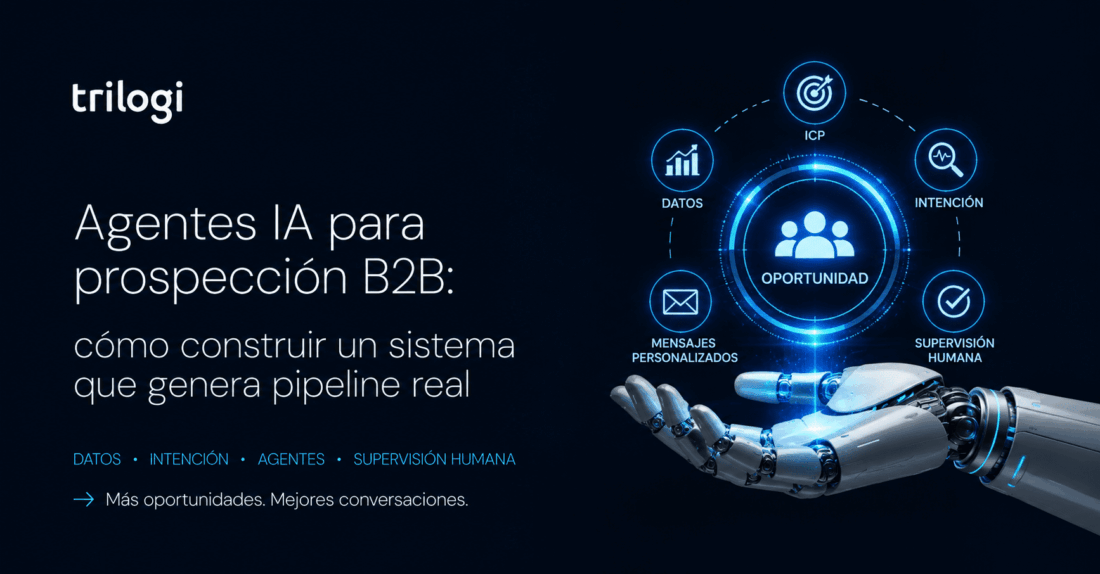
An AI sales assistant is essentially a "digital SDR" that handles repetitive, high-volume outbound tasks:
- Find and enrich leads based on your ICP (Ideal Customer Profile)
- Write relevant and personalized messages
- Execute cadences (first contact + follow-ups)
- Detect signs of interest and prioritize leads
- Prepare the transfer to the sales department when there is genuine intent
The key difference from older automations is that the assistant doesn't just send templates: it uses context (industry, role, situation, signals) to tailor the message and maintain a useful conversation.
In short: AI does not replace the salesperson, but it does prevent the salesperson from becoming a machine performing mechanical tasks. This is the turning point that is already being seen in the market: agents who enrich lists, verify data, personalize messages, and follow up until they schedule meetings when there is interest. modaes.com
Why traditional B2B prospecting fails (even if your team is good)
Most outbound strategies fail for four reasons:
1) Time (too much) spent on low-value tasks
Searching for profiles, validating emails, copying/pasting messages, recording activity... It's necessary work, but it's not work that closes sales.
2) Low response when shooting at volume
For example, in cold email, a healthy response rate typically ranges from 1% to 5%.
That means that if your targeting or message isn't refined, volume only amplifies the problem.
3) Personalization that does not scale
True customization boosts performance, but doing it manually for hundreds of accounts is unfeasible.
4) Inconsistent follow-up
Money in outbound is almost always on the second, third, or fourth touch. If follow-up depends on memory or "when there's a gap," the pipeline becomes unpredictable.
What changes when you automate prospecting with AI
When you introduce an AI sales assistant into your prospecting, it's not just speed that changes. It changes the operating model.
1) Better defined and prioritized leads
AI helps you operate with a real ICP: you filter, enrich, and detect which profiles are a good fit before investing human effort.
2) Personalized messages at scale
En lugar de “hola {Nombre}”, hablamos de personalización por:
- Role and responsibilities
- Market sector and context
- Public signals (activity, initiatives, growth, expansion)
- Probable pain + value hypothesis
Result: the message sounds relevant, not mass-produced.
3) Constant 24/7 activity without burning out the equipment
An assistant can continuously conduct prospecting activities while your team focuses on discovery, demos, negotiation, and closing.
4) Follow up with cadence (not with guilt)
The system insists with criteria: same objectives, but without oversights, without laziness, and without improvisation.
5) Qualification and handoff to the salesperson at the right time
When there are clear signals (questions, objections, interest, proposal for next steps), the lead's priority increases and is transferred with context.
Multichannel prospecting: cold email + LinkedIn (the combination that converts best)
In practice, the most robust approach is multichannel:
- Cold email to open doors with control, measurement, and A/B testing
- LinkedIn to build trust, social context, and natural conversation
- Coordinated cadences so as not to "step on each other's toes" (not all at once)
A very effective pattern:
- Short email with hypothesis + question
- Light interaction on LinkedIn (human signal)
- Invitation to connect without pitching
- Short message of exploration after accepting
- Value-based follow-up with AI agents (insight, example, mini-case)
This reduces rejection and increases the likelihood of a response, because the prospect "places" you before responding.
Success story: Punto Blanco (recruiting distributors with AI agents)
Here we arrive at a real case that we have promoted at TRILOGI.
Punto Blanco, a Catalan brand renowned for its track record in lingerie and hosiery, faced a very common challenge in B2B: growing and opening up the market without increasing the size of the sales team.
As part of its expansion, the focus was on:
- Identify national and international distributors and target accounts
- Start conversations with relevant messages
- Maintain seamless tracking
- Arrive at meetings with aligned profiles
This case is cited as an example of the application of the AI agent model in B2B sales promoted by Trilogi. Marketing4eCommerce
Video: Punto Blanco success story explained by Toni Valldaura, its Commercial Director
How to implement an AI sales assistant without losing control (recommendation from Trilogi)
At Trilogi, we recommend starting with a practical and manageable approach:
Step 1) Define the ICP precisely (and with exclusions)
It's not just "who yes," but "who no." Outbound improves when you reduce dispersion.
Step 2) Set a cadence and a target per touch
Each message must fulfill a function:
- Start conversation
- Validate pain
- Provide insight
- Request next step
Step 3) Control the "brand tone"
AI should sound like your company: formality, approachability, industry vocabulary, way of asking questions.
Step 4) Measure what matters
Don't obsess over openings. Prioritize:
- Actual response rate
- Positive response
- Meetings
- Conversion to opportunity
Step 5) Define when the human enters
AI prepares the ground. The salesperson steps in when:
- there is an obvious fit
- there is intent
- there is negotiation that requires judgment
In fact, our AI agent systems automatically tag conversations based on their intent:

Conclusion: B2B prospecting of the future is collaborative (AI + sales team)
Outbound marketing is not dead. What is dead is outbound marketing based on volume without relevance.
The AI sales assistant allows you to professionalize prospecting: more focus, more consistency, more useful conversations... without burning out the team.
And cases such as Punto Blanco demonstrate that this approach can accelerate expansion and distributor recruitment without proportional growth in commercial structure.
Frequently asked questions
It works especially well when there is a clear ICP, medium/high ticket, or a need to scale prospecting without expanding the team.
It depends on the market. Email provides more control and scale; LinkedIn provides trust and context. The most solid approach is usually a multi-channel one.
It shouldn't. The best results come when AI takes on repetitive tasks and SDRs focus on what requires judgment: discovery, advanced qualification, and closing.