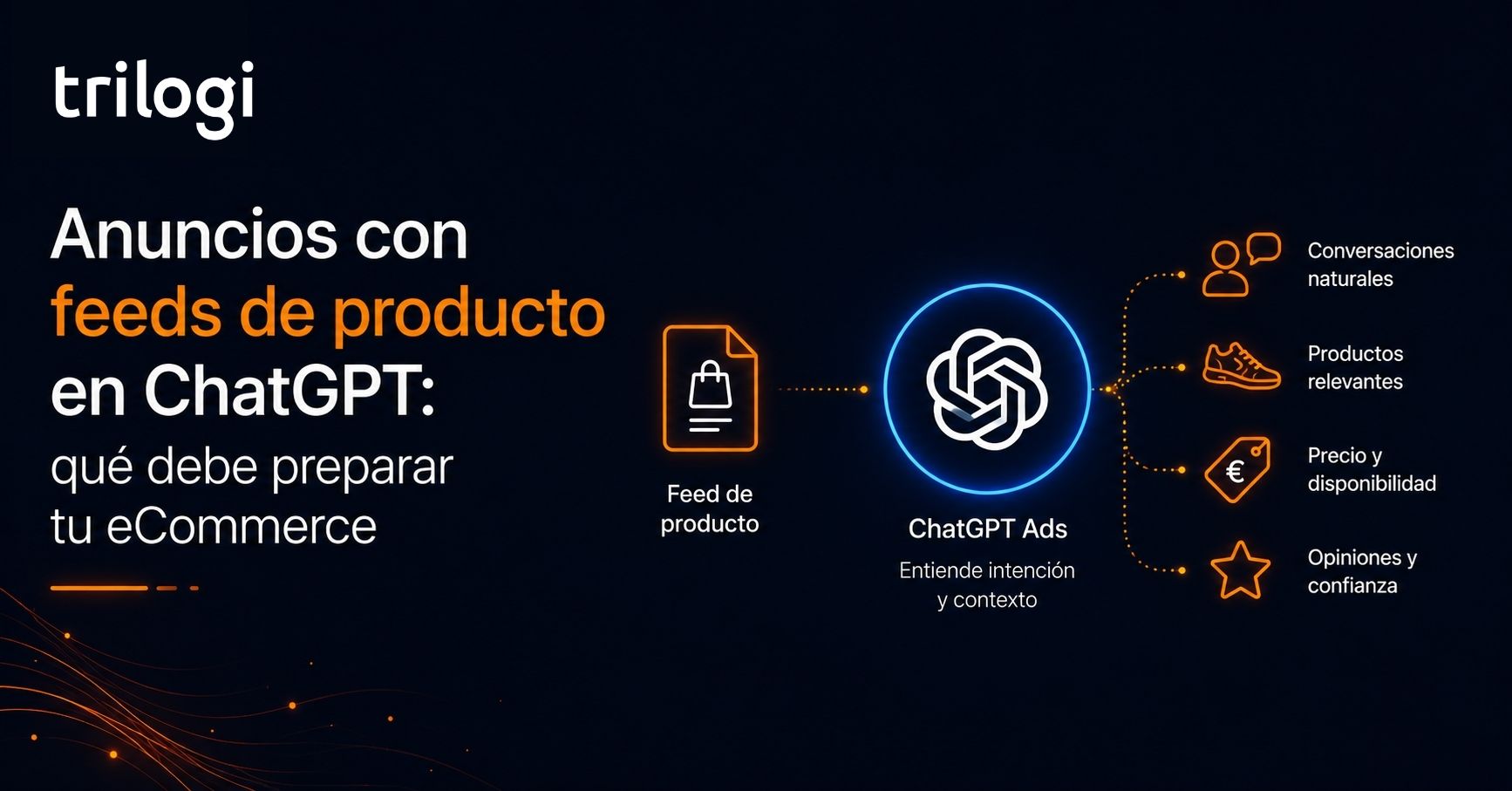
ChatGPT is beginning to venture into territory that e-commerce businesses know very well: product catalogs, purchase intent, and feed-based advertising. OpenAI has launched a beta version of campaigns created from product feeds within ChatGPT Ads, a feature that allows retail advertisers to upload complete catalogs and generate ads at scale from that data. Marketing4eCommerce reported on this development on June 12, 2026, noting that advertisers will be able to work with feeds containing up to 2 million items.
For brands, data analysis shouldn’t be limited to advertising. This trend confirms something more profound: the product catalog is becoming a central element for visibility, competition, and conversion in conversational environments. At Trilogi, we see this as a natural evolution of e-commerce SEO, paid media, and GEO (Generative Engine Optimization), because data quality will become increasingly important for AI to understand what you sell, when to display it, and why it should be relevant to a search or conversation.
What Are Product Feed Ads on ChatGPT?
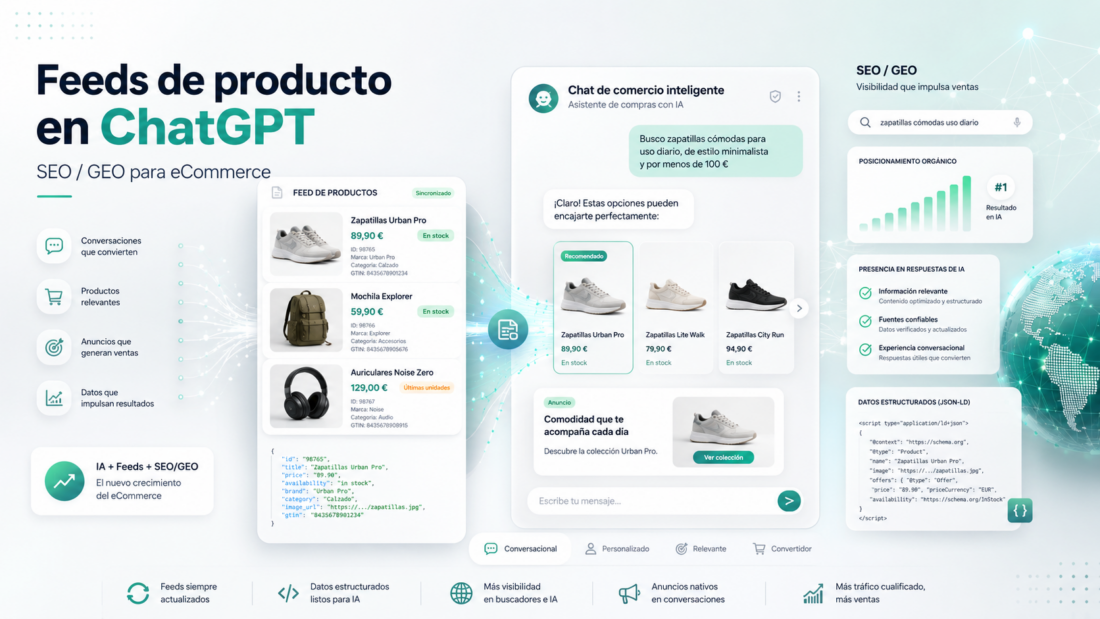
Product feed-based campaigns allow retail advertisers to upload a feed to Ads Manager and create ads from that catalog. According to OpenAI’s documentation, these campaigns are designed specifically for retailers with large or frequently changing catalogs, as they make it easier to create campaigns at scale, connect relevant products with high-intent conversations, and keep details such as price, availability, and metadata up to date.
The difference from traditional advertising is clear: instead of manually creating each ad, the e-commerce platform feeds structured data into OpenAI. From there, Ads Manager can select products, apply filters by ad groups, and generate ads where the title and description come directly from the feed. This makes the quality of your catalog a critical factor: if your titles, descriptions, images, URLs, prices, or inventory data aren’t well-crafted, your ad performance will suffer as well.
There is one important caveat: During this beta, OpenAI clarifies that feed products are only eligible for ads and will not appear in organic ChatGPT conversations, although the company notes that it may offer that capability in the future.
Why Is This Relevant for an E-Commerce Business?
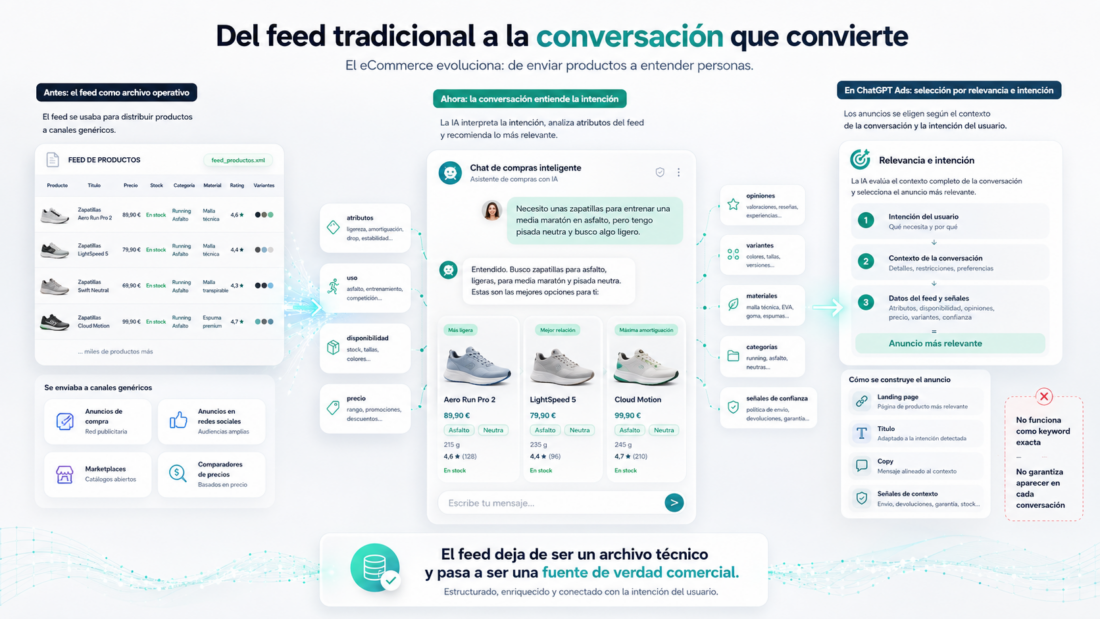
Until now, many marketing teams have treated feeds as an operational requirement for Google Merchant Center, Meta Ads, marketplaces, or price comparison sites. With ChatGPT Ads, the feed takes on a different context: that of a conversation in which the user isn’t always searching for an exact keyword, but rather describing a need.
For example:
“I need a pair of running shoes to train for a half marathon on pavement, but I have a neutral foot strike and I’m looking for something lightweight.”
In a search like this, AI needs more than just a product. It needs to understand attributes, usage, availability, price, reviews, variants, materials, categories, and trust signals. That’s why the feed is no longer just a technical file—it has become a source of business intelligence.
OpenAI explains that ad selection is primarily based on relevance to the context and intent of the conversation, taking into account inputs such as the landing page, title, ad copy, and contextual signals configured in the ad group. These signals do not function as exact keywords nor do they guarantee that ads will appear in specific conversations.
Current Status and Availability
As of June 15, 2026, ChatGPT Ads is still in beta. OpenAI states that Ads Manager Beta is available to advertisers in the United States, Australia, New Zealand, and Canada, and that it plans to expand it to the United Kingdom soon. Availability may vary by country and region.
Meanwhile, ads on ChatGPT have been rolled out to users in the United States, the United Kingdom, Australia, New Zealand, and Canada, and may appear on the Free and Go plans. OpenAI also clarifies that the ads are separate from ChatGPT’s responses, are labeled as sponsored, and do not influence the model’s responses.
For a Spanish or European e-commerce business, this doesn’t mean “waiting.” It means getting ready. The advantage will lie in having a clean, automated, and optimized product catalog ready when the channel becomes available or when new conversational commerce integrations are launched.
Platforms such as LogiCommerce, Shopify, and PrestaShop—which we use at Trilogi—are already prepared for this new scenario.
Product Feed Requirements for OpenAI
OpenAI refers to a technical specification for structuring the feed. The goal is for ChatGPT to be able to index and display products with up-to-date prices and availability, based on defined fields, data types, constraints, and validation rules.
General Submission Requirements
| Area | Requirement | What This Means for Your E-Commerce Business |
|---|---|---|
| Feed Template | Full snapshot feed: complete export of the catalog as the single source of truth | It is advisable to automate a complete export from eCommerce, ERP, PIM, or middleware |
| Cadence | OpenAI recommends updating at least once a day | Inventory, pricing, and promotions must be updated frequently |
| Delivery | Upload via SFTP | A secure technical connection and a recurring process need to be set up |
| Formats | Preferably hardwood flooring; also jsonl.gz, csv.gz and tsv.gz | The technical team must choose a maintainable and scalable format |
| Coding | UTF-8 | Avoid mistakes involving special characters, languages, and symbols |
| File name | Stable name; the previous snapshot must be overwritten | It's not a good idea to generate different names with each update |
| Shards | Recommended for up to 500,000 items per shard and files smaller than about 500 MB | Large catalogs should be divided into smaller, stable segments |
| Validation | Start with a sample of about 100 products, validate required fields, and perform QA before the first full snapshot | Reduce errors before launching the entire catalog |
These requirements are taken from OpenAI's official guide to submitting feeds via file, which also warns of common errors such as missing required fields, obsolete field names, or malformed values.
Minimum and maximum feed size
For feed-based campaigns, OpenAI specifies that the feed must contain a minimum of 1,000 products and a maximum of 2 million products.
This excludes very small catalogs, but opens up a clear opportunity for medium and large retailers, vertical marketplaces, DTC brands with many variants, fashion, home decor, electronics, sports, specialty food, and B2B businesses with broad product ranges.
Main Required Fields
The OpenAI feed includes required and optional fields. Among the required or critical fields are:
| Block | Key Fields |
|---|---|
| OpenAI Flags | is_eligible_search, is_eligible_checkout; is_eligible_ads It is optional for checking ad eligibility |
| Basic Information | item_id, title, description, url |
| Product Information | brand |
| Media | image_url |
| Price | price, with ISO 4217 currency code |
| Availability | availability, with values such as in_stock, out_of_stock, pre_order, backorder or unknown |
| Seller | seller_name, seller_url |
| Returns | return_policy |
| Geotargeting | target_countries, store_country |
| Conditionals | availability_date if the product is available for pre-order; seller_privacy_policy and seller_tos if checkout is enabled |
The specification also defines relevant restrictions: item_id It must be stable and unique for each variant; title It must be no more than 150 characters long, and you should avoid excessive use of uppercase letters; description It supports up to 5,000 characters of plain text; the URL must resolve correctly; the main image must be a JPEG or PNG; and countries must use ISO 3166-1 alpha-2 codes.
Optional fields that can make a difference
Beyond the required minimum, there are areas that can enhance relevance and trust:
product_category, to better categorize the product.material, dimensions, weight, and physical characteristics.additional_image_urls, video, or 3D model.sale_price, promotional dates, and pricing per unit.- Variant data such as
group_id,variant_dict, size, color, or gender. shipping, shipping methods and delivery times.review_count,star_rating, reviews, and frequently asked questions.related_product_idandrelationship_type, useful for cross-selling, accessories, or substitutes.geo_priceandgeo_availability, for prices or inventory by region.
OpenAI includes these blocks in its product framework to improve availability, seller context, returns, performance metrics, compliance, reviews, related products, and geographic data.
How to Create a Campaign from a Feed
OpenAI's official workflow consists of several steps:
- Create a product feed from the Tools > Feeds tab in Ads Manager.
- Configure the SFTP connection using a password or SSH key.
- Upload and validate the feed.
- Create a campaign and select the "Product feed" type.
- Create an ad group, select the feed, and apply product filters.
- Create an ad template.
- Review the feed, product count, titles, descriptions, images, landing pages, budget, bid, and targeting before submitting the campaign for review.
OpenAI notes that feed processing can take anywhere from a few minutes to several hours, depending on the size, and that products are processed gradually. It also recommends using the field ads_metadata when standard filters are not sufficient, for example, to group products by bidding_tier or product_line.
What an e-commerce business should audit before using ChatGPT Ads
Enabling product feeds in ChatGPT shouldn't be approached as simply "uploading a CSV and testing it out." To do it right, it's best to review five layers.
1. Catalog Quality
Titles should be clear, distinctive, and useful. “Model X Sneaker” isn’t enough. In a conversational context, it may be more helpful to include the product type, use, gender, color, material, or main attribute—without resorting to keyword stuffing.
Descriptions should explain benefits, use cases, compatibility, materials, dimensions, and common questions. If the AI needs to understand when to recommend a product, the description should address the user's intent, not just list features.
2. Data Architecture
The feed must come from a reliable source: an e-commerce platform, ERP, PIM, DAM, or middleware. If each channel has different data, inconsistencies will arise in pricing, inventory, variants, or images.
This is where an agency like Trilogi adds value: it’s not just about marketing, but about integrating the product catalog, business operations, technology, and analytics. And that’s how we define ourselves—as an e-commerce agency and digital consulting firm—offering strategy, marketing, technology, design, and AI services focused on digital growth.
3. Product SEO and GEO
The ChatGPT Ads feed also provides an opportunity to assess how an AI understands your product catalog. At GEO, the question isn’t just “Does this URL rank?”, but “Can an AI identify this product as an appropriate solution to a specific need?”
Trilogi is already working on GEO and AEO as the next evolution of SEO for online stores, optimizing content for search engines using AI, generative responses, and conversational experiences.
4. Landing Pages and Post-Click Experience
OpenAI can drive traffic to the product detail page. If the landing page is slow, doesn't show the same price as the feed, displays a variant that's out of stock, or doesn't meet the user's intent, the problem won't be the channel—it will be the experience.
A competitive feed must be accompanied by solid PDPs: high-quality images, clear product variants, delivery information, visible return policies, reviews, FAQs, real-time availability, and frictionless calls to action.
5. Measurement and Profitability
ChatGPT Ads should not be analyzed in isolation. OpenAI notes that Ads Manager Beta provides metrics such as impressions, clicks, spend, CTR, average CPC, average CPM, and conversions. It also allows you to use UTM parameters on landing pages to analyze traffic from external tools.
The key will be to align campaigns with margin, inventory, repeat business, LTV, return rate, and business priority. Not all products in the catalog should be given equal weight.
Checklist for Setting Up Your Product Feed
Before launching or adapting your feed for ChatGPT Ads, review the following:
- Does the catalog have at least 1,000 eligible products?
- Does each variant have a
item_idunique and stable? - Are the titles descriptive, easy to read, and not overloaded with capital letters?
- Are the descriptions in plain text and do they explain real-world uses?
- Do the product URLs resolve correctly and use HTTPS?
- Is the main image high-quality, accessible, and consistent with the product?
- Are the price, currency, inventory, and promotions up to date?
- Are the variants grouped correctly?
- Is there information about shipping, returns, and the seller?
- Are there any reviews, ratings, or FAQs that could help build trust?
- Can rules be created based on margin, season, category, or priority?
- Can the feed be updated daily and consistently?
- Are the landing pages consistent with the feed?
- Are the UTMs and conversion events set up?
ChatGPT Ads and GEO: An Opportunity Beyond Paid Media
Although OpenAI clarifies that the products in the feed in this beta do not appear in organic conversations, the direction is clear: conversational engines need structured, reliable, and up-to-date data to connect users with products.
That’s why preparing the feed isn’t just a paid media activity. It’s an investment in catalog architecture, technical SEO, product content, and visibility on generative search engines. E-commerce sites that already have complete product listings, clean taxonomies, reliable inventory data, well-structured attributes, and useful content will be better positioned to adapt to any changes in the channel.
At Trilogi, we combine e-commerce SEO, GEO, data strategy, e-commerce technology, and traffic acquisition so that your product catalog isn’t just a database, but a growth asset. Our e-commerce SEO approach focuses on searches that directly impact sales, technical audits, migrations, rich snippets, category architecture, content, and conversion.
Conclusion: The feed will be the new conversational showcase
Ads featuring product feeds on ChatGPT are a clear sign of where e-commerce is headed. Users no longer just search on Google, filter results on marketplaces, or compare options on social media. They also chat with AI assistants to discover, compare, and make decisions.
To compete in this environment, e-commerce businesses need much more than just campaigns. They need clean data, useful content, robust feeds, reliable metrics, and a strategy that integrates SEO, GEO, paid media, and technology.
The question isn't whether your brand should prepare its catalog for ChatGPT Ads. The question is whether your catalog is ready for AI to understand, compare, and select it when the user is ready to buy.
Do you want to prepare your e-commerce site for the new generation of conversational searches and ads? At Trilogi, we help you audit your product catalog, optimize your feed, improve your product listings, and design a sales-oriented SEO/GEO strategy.
Frequently Asked Questions About the Feed for Creating Ads on ChatGPT
These are ChatGPT Ads campaigns that allow retail advertisers to upload a product feed and create ads based on their catalog. They are designed for e-commerce businesses with extensive or frequently changing catalogs and to showcase relevant products in conversations where users intend to make a purchase.
OpenAI states that feeds must contain a minimum of 1,000 products and a maximum of 2 million products.
Not during the beta. OpenAI clarifies that feed products will only be eligible for ads and will not appear in organic conversations, although it may offer that capability in the future.
OpenAI recommends a full snapshot feed delivered via SFTP, updated at least once a day. The preferred format is Parquet, although other formats are also supported jsonl.gz, csv.gz and tsv.gz, encoded in UTF-8.
Key areas include item_id, title, description, url, brand, image_url, price, availability, seller_name, seller_url, return_policy, target_countries and store_country, as well as flags such as is_eligible_search e is_eligible_checkout.
Yes. Although ad availability remains limited by country, preparing the feed helps improve the quality of the catalog, strengthen SEO/GEO, organize product data, and enable you to reach new conversational commerce channels sooner when they become available. OpenAI notes that Ads Manager Beta is still in development and that availability may expand over time.