The problem with automated lead generation isn't usually artificial intelligence.
The problem is treating it as if it were software that you install, activate, and then it starts generating meetings on its own.
This approach leads many companies to repeat the same pattern: they purchase tools, connect databases, generate thousands of messages, and expect that volume to automatically translate into a pipeline. For a few weeks, it seems like the system is working because activity increases. Then the problems arise: incorrect contacts, generic messages, misinterpreted responses, declining deliverability, and meetings with companies that should never have been included in the campaign.
At Trilogi, we have a different understanding of AI agents.
An agent is not the sales system. It is a component within a go-to-market system designed to identify opportunities, interpret context, and trigger the appropriate action at the right time.
That's why true value doesn't lie in the technology stack alone. It lies in the engineering that connects strategy, data, automation, and human judgment.
That's the job of the GTM Engineer.
What is an AI-powered lead generation system?
An AI-powered lead generation system for B2B is an infrastructure capable of executing and coordinating some of the operational work required to generate new business opportunities.
Among other tasks, it can:
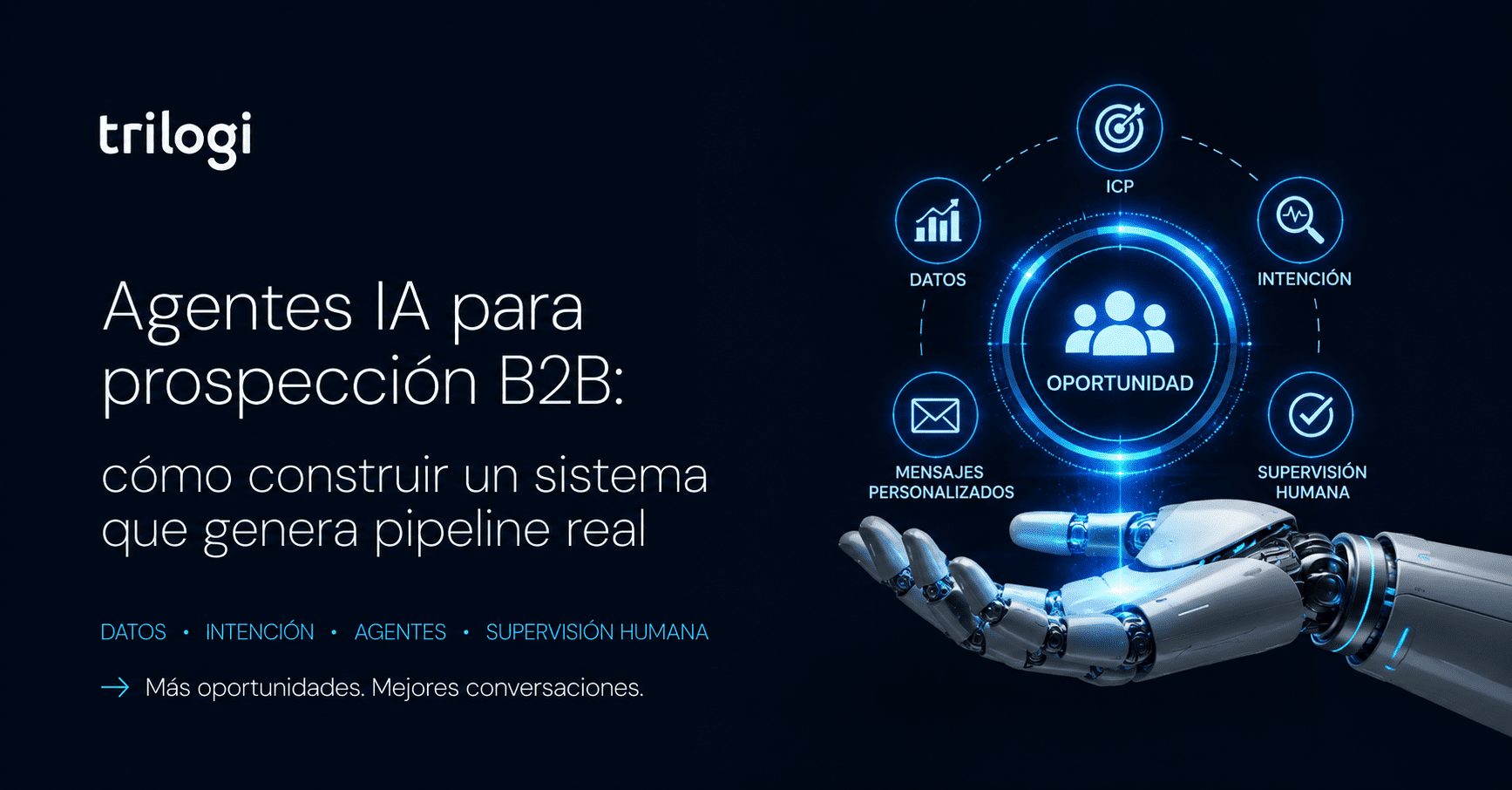
- Identify companies that match the ideal customer profile.
- Identify the relevant decision-makers.
- Enrich and verify contact information.
- Identify signs of intent or moments of change.
- Create messages tailored to each company and individual.
- Run tracking sequences.
- Sort the answers.
- Update the CRM.
- Notify the sales team when an opportunity arises.
- Prepare information for a meeting.
The difference from traditional automation is that the system isn't limited to executing a rigid sequence. It can combine information, apply rules, generate content, and decide which workflow to trigger.
But that doesn't mean it can operate without oversight.
Today's AI agents are particularly effective at repetitive, structured, and high-volume tasks. They are much less reliable when it comes to interpreting nuances, handling a complex objection, understanding a client's internal policies, or building a relationship of trust.
That's why the most robust systems don't try to completely replace salespeople. They use AI to expand their capabilities.
The most common mistake: confusing technology with business strategy
There is enormous pressure in the market to find “the best” AI-powered lead generation tool.
However, the tool is rarely the main factor in success.
An agent can compose messages, search for contacts, or run workflows, but cannot fix an unclear value proposition on their own. Nor can they turn a poor-quality database into an effective segmentation strategy.
Technology multiplies the system it encounters.
If the ICP is vague, it leads to faster contact with companies that aren’t of interest. If the data is out of date, it increases the likelihood of sending messages to incorrect addresses. If the sales message is weak, it results in more variations of a pitch that still fails to resonate with the market.
Automating a poorly designed process doesn't improve it. It just scales it.
This is why an AI agent project should begin before selecting the tools.
You should start with business-related questions:
- Which companies have a real need?
- What characteristics do our best customers have in common?
- Which roles are involved in the decision?
- What situations typically trigger a purchase window?
- Which issues are important enough to warrant starting a conversation?
- When should a person step in?
- What metrics will show that we're generating business—not just activity?
A GTM Engineer translates the answers to these questions into data, rules, automations, and control mechanisms.
The 10-20-70 Rule: A Useful Way to Understand the Success of AI Agents
One way to visualize the distribution of effort is the 10-20-70 rule:
- 10%: technology and agent autonomy.
- 20%: human oversight, judgment, and optimization.
- 70%: data, segmentation, ICP, and sales signals.
| Phase | Time Allocation | Key Activities | Success Metrics |
|---|---|---|---|
| 70%: Database | 60% of the initial effort (2–3 weeks) | • Define the essential criteria for the ICP • Create an account scoring model • Enrich and verify contact data • Configure signal-based triggers • Remove duplicates and excluded contacts from the CRM | • Data accuracy greater than 90% • Clear segmentation into levels 1, 2, 3, and 4 • Bounce rate less than 5% • Signal coverage in more than 40% of target accounts |
| 10%: AI Configuration | 15% of the initial effort (1 week) | • Implement an AI SDR tool • Configure the tone of voice and behavior limits • Create a content library • Set up integrations with CRM, email, and calendar | • AI results align with the brand voice • Deliverability greater than 95% • Personalization quality greater than 7/10 |
| 20%: Human supervision | 25% of sustained effort (4–6 hours per week) | • Review email samples each week • Categorize and analyze all responses • Monitor deliverability metrics • Adjust segmentation and messaging • Conduct biweekly strategic reviews | • Response rate of 1–2% or higher in signal-based campaigns • Positive sentiment in more than 70% of responses • Conversion to meetings exceeding 40% of positive responses • Sustained deliverability above 95% |
It should not be interpreted as a universal mathematical formula, but rather as a design principle: most of the result depends on everything surrounding the tool.
Companies often reverse this ratio. They spend weeks comparing platforms and very little time analyzing successful trades, cleaning up the CRM, defining exclusions, or identifying buy signals.
The result is a technically advanced system that does not know with sufficient precision whom to contact, why to do so, or what message to use.
The agent's autonomy is visible and appealing. Data quality, business taxonomy, prioritization rules, and human review are less noticeable. However, it is these layers that determine the project's profitability.
The Seven Keys to Making an AI-Powered Lead Generation System Work
1. Define an operational ICP, not a generic description
A useful ICP for automation cannot be limited to phrases such as “medium-sized industrial companies” or “fashion brands interested in international expansion.”
The system needs verifiable criteria.
For example:
- Priority countries and markets.
- Included and Excluded Sectors.
- Minimum and maximum size.
- Distribution model.
- Technologies Used.
- Approximate revenue.
- Number of employees.
- International presence.
- Recent organizational changes.
- Decision-makers.
- Circumstances that result in an account being disqualified.
It is also important to define the negative ICP: companies, positions, or circumstances that should not be included in the process.
The more precise this definition is, the less the system will rely on generic messages, and the better it will be able to tailor the proposal to the context of each account.
2. Build a reliable and continuously updated database
The quality of the output will never exceed the quality of the input data.
Before activating campaigns, you must verify the following:
- Existence and Operations of the Company.
- Contact's current position.
- The Relationship Between the Profile and the Decision.
- Validity of contact information.
- Duplicates.
- Previous history in the CRM.
- Exclusions and Terminations.
- Sales territory.
- Recent relevant developments.
This work doesn't end when the campaign launches. B2B data is constantly changing: people change jobs, companies restructure, and business priorities evolve.
That is why enrichment must be an integral part of the system, not a one-time operation.
3. Moving from static lists to signals of intent
Traditional prospecting is based on one question: “Does this company resemble our ideal client?”
Signal-based prospecting adds a second, much more powerful question: “Is there a reason to reach out now?”
One company may be a perfect fit for the ICP but not in a position to make a purchase. Another may show a shift that creates an immediate opportunity.
Some key indicators are:
- Repeated visits to product, service, or pricing pages.
- View success stories.
- Interaction with specialized content.
- Hiring new managers.
- Expanding into new markets.
- Team Growth.
- Funding rounds.
- Changes to the technology stack.
- Launch of new business lines.
- Searches related to a competitor or a specific solution.
- Responses, repeated engagements, or interactions with previous campaigns.
Not all signals have the same value or duration.
A recent visit to a business website may require a quick response. A change in direction or international expansion may create a longer window of opportunity.
The system must score, combine, and set expiration dates for the signals. It must also explain to the sales representative why an account has been prioritized.
A single number provides no context. An alert stating “new sales director, expansion in France, and a visit to the B2B solutions page” does allow you to prepare for a relevant conversation.
The key isn't to accumulate intent data. It's to turn it into concrete business action.
4. Design the entire workflow, not just a chain of emails
An AI agent system shouldn't be limited to generating and sending emails.
You must coordinate various functions:
- To detect or receive a signal.
- Check whether the account meets the ICP criteria.
- Enrich the information.
- Identify the decision-makers.
- View the CRM history.
- Select the appropriate message and channel.
- Perform the action.
- Analyze the response.
- Update internal systems.
- Forward the opportunity to the sales team.
In some cases, the right course of action will be to send an email. In others, it will be to create a task, initiate an interaction on LinkedIn, start a nurturing sequence, or do nothing for now.
The system's intelligence is not measured by the number of automated processes, but by its ability to choose the next best course of action.
5. Incorporate human oversight by design
Human review is not a temporary measure until the AI “learns.”
It is a permanent layer of the system.
During the early stages, monitoring should be particularly thorough. It is advisable to review the messages generated, read the actual responses, verify the classification of opportunities, and analyze the quality of the meetings.
Subsequently, the review can focus on samples, exceptions, and deviations.
The team should pay particular attention to:
- Accuracy of the information used.
- Alignment with the value proposition.
- Brand tone.
- True personalization.
- Handling Objections.
- Requests for cancellation.
- Negative responses.
- Sensitive cases.
- Deliverability.
- Changes to the conversion.
- The emergence of new business models.
AI operates at a speed that a person cannot match. That is precisely why it needs limits.
A human error affects one conversation. An automated error can affect thousands.
6. Properly design the handoff between AI and sales
One of the most delicate issues is deciding when the agent's work ends and the sales team's work begins.
If the handoff occurs too early, the sales representative receives leads without sufficient context. If it occurs too late, the agent may derail a conversation that already required human judgment.
The commercial input can be activated when:
- The contact has expressed explicit interest.
- Ask a specific question.
- A relevant objection arises.
- Request business information.
- Several stakeholders are involved.
- The account has high potential value.
- The proposal needs to be adapted.
- The conversation requires negotiation or industry knowledge.
The handoff must include all accumulated information: reason for selection, detected signals, messages sent, responses received, account data, and any conversation threads.
The goal isn't to provide a lead. It's to provide an opportunity with context.
7. Measure the pipeline, not the volume
AI agents make it very easy to increase activity.
That is why metrics such as the number of contacts processed, emails sent, or messages generated can be misleading.
Key metrics should be linked to the business:
- Positive responses.
- Qualified conversations.
- Meetings held.
- Opportunities created.
- Pipeline generated.
- Opportunity cost.
- Conversion by segment.
- Conversion by signal.
- Length of the business cycle.
- Attributed revenue.
- Quality as perceived by the sales team.
Operational health indicators should also be monitored:
- Rebounds.
- Spam complaints.
- Resignations.
- Domain Reputation.
- Personalization errors.
- Incorrectly categorized contacts.
- Meetings rejected due to a lack of compatibility.
The purpose of a GTM system is not to do more things. It is to generate better business results through a smarter use of resources.
The technology stack is replaceable; the system is not
Tools are evolving rapidly.
A provider that offers the best enrichment capabilities today may be surpassed tomorrow. Language models change, new channels emerge, and platform costs fluctuate.
That's why it doesn't make sense to build a strategy around a single tool.
The architecture should be modular. Each component should be able to evolve without requiring a complete overhaul of the business process.
At Trilogi, we don't view our service as simply selling a fixed set of licenses or integrations. We don't deliver an isolated stack and leave it up to the customer to figure out how to use it.
We design the business system that will run on that stack.
Our process consists of five stages:
- Business Assessment. We analyze the market, the sales process, the value proposition, and the actual potential for automation.
- Definition of the ICP. We translate business insights into operational criteria for segmentation, prioritization, and exclusion.
- Message design. We develop arguments, variations, and rules tailored to the identified profiles and situations.
- Agent-based architecture. We connect data sources, business logic, channels, CRM, and control mechanisms.
- Implementation and ongoing optimization. We review results, identify deviations, and adjust the system based on real-time market data.
Technology enables execution. Human review enables learning, correction, and decision-making.
This support is especially important because lead generation does not take place in a static environment. The market responds, new objections arise, certain segments convert better than others, and some messages lose their effectiveness.
A system that does not incorporate continuous learning begins to deteriorate from the moment it is activated.
What does a GTM Engineer actually contribute?
The GTM Engineer works at the intersection of business, sales, marketing, data, and technology.
This person isn't just someone who can connect applications. Their responsibility is to transform a business strategy into an executable and measurable infrastructure.
Its functions include:
- Translate the ICP into data rules.
- Design scoring models.
- Identify signs of intent.
- Define triggers and flows.
- Connect CRM, channels, and information sources.
- Create guardrails for agents.
- Monitor the quality of the outputs.
- Design experiments.
- Analyze results.
- Coordinate the handoff with Sales.
- Adjust the system based on market response.
This discipline avoids two common extremes: a business strategy that cannot be executed at scale and a technology infrastructure that is disconnected from business objectives.
The winning model isn't AI versus humans
Viewing sales automation as a competition between AI agents and sales teams leads to a mistaken conclusion.
The right question isn't which jobs AI can replace, but which division of labor produces the best results.
These agents are particularly effective in:
- Research.
- Enrichment.
- Prioritization.
- Preparing messages.
- Conducting follow-ups.
- Initial classification.
- System Updates.
- Background Information.
People continue to play an essential role in:
- Diagnosis.
- Strategy.
- Interpreting Nuances.
- Handling Objections.
- Building Trust.
- Negotiation.
- Complex decisions.
- Strategic Account Relations.
The hybrid model allows sales professionals to spend less time searching, copying, updating, and following up, and more time understanding, engaging, and closing deals.
Agents do not eliminate the need for judgment. They amplify its impact.
How We See the Future of Sales Prospecting with AI
The next step won't simply be about creating better emails.
We will see GTM systems that are more connected, contextual, and event-driven.
From Mass Campaigns to Signal-Driven Activations
The "select a list and run a sequence" approach will become less important. Systems will monitor the market and act when a relevant combination of signals occurs.
Prospecting will be less periodic and more continuous.
From individual agents to specialized teams of agents
A single general-purpose agent will give way to architectures with distinct functions: research, enrichment, scoring, message generation, quality control, response classification, and CRM updates.
The advantage will not lie in each agent individually, but in their coordination.
From Superficial Personalization to Cumulative Context
Mentioning the company's name or a recent publication will no longer be considered personalization.
The systems will incorporate context memory, interaction history, organizational changes, digital signals, and industry knowledge to tailor the conversation.
From dashboards to automated actions
Teams will no longer have to check multiple dashboards to identify opportunities.
The relevant information will be accompanied by a recommendation, a prepared task, or an action already carried out in accordance with previously approved rules.
From Unlimited Automation to Governance by Design
Quality, privacy, brand reputation, and deliverability will take center stage.
The most mature systems will include performance limits, traceability, exception review, decision logging, and shutdown mechanisms.
More AI will mean a greater need for human judgment
As implementation becomes cheaper and more accessible, the competitive advantage will no longer lie in “using AI.”
It will depend on what to automate, using what information, under what rules, and with what level of control.
That is why we believe the future belongs to companies that combine specialized agents with professionals capable of designing and managing growth systems.
It won't be the one who sends the most messages who wins. It will be the one who best understands the market and responds first with a relevant proposal.
Conclusion: You don't need more automation—you need a GTM system
AI agents can transform B2B lead generation, but they are neither a standalone nor an immediate solution.
To create a pipeline, they need:
- An accurate ICP.
- Reliable data.
- Relevant signs.
- Strong messages.
- A well-orchestrated architecture.
- Rules for Participation.
- Human supervision.
- Commercial measurement.
- Continuous optimization.
The technology stack is only one part of it.
The difference between increasing noise and creating opportunities lies in the system's design and the people who oversee it.
At Trilogi, we design AI-powered agent systems for B2B prospecting that identify target companies, locate decision-makers, personalize outreach, and generate qualified meetings.
But before engaging any agent, we assess whether the model makes sense for the market, the value proposition, and the company’s sales process.
Because it's not about implementing artificial intelligence.
The goal is to build new capacity for growth.
Frequently Asked Questions About AI Agents and B2B Lead Generation
It is a system that automates tasks using an artificial intelligence agent, such as identifying companies, enriching contact information, personalizing messages, following up, and initially classifying opportunities.
It can handle a significant portion of the operational work, but it still requires human oversight. Strategy, complex conversations, handling objections, and building relationships continue to require professional judgment.
You need a clear value proposition, a functional ICP, reliable data, messages tailored to the market, a minimally structured CRM, and a defined process for handing off opportunities to the sales team.
These are behaviors or events that indicate a company may be nearing a decision: visits to business-related web pages, interaction with content, hiring of executives, financing, expansion, or technological changes.
Because agents can make contextual errors, misinterpret responses, stray from the brand’s tone, or scale up a strategy that isn’t working. Human review allows for quality control and helps improve the system through market insights.
It tends to add the most value in B2B companies with a clearly defined ideal customer, consultative sales processes, a need to recruit distributors, international expansion strategies, or sales teams that spend too much time on manual tasks.
Purchasing tools provides functionality. GTM Engineering defines how data, rules, messages, agents, CRM, and the sales team should be connected to generate measurable results.