Is your e-commerce site still running on PrestaShop 1.6, 1.7, or an earlier version, and are you wondering if it's time to upgrade?
Migrating an online store isn't just about installing a new version. In another post, we already discussed how to update my PrestaShop store step by step. You need to review modules, custom developments, integrations with ERP or CRM systems, data, the server, performance, SEO, and, above all, ensure that the business can continue to operate normally.
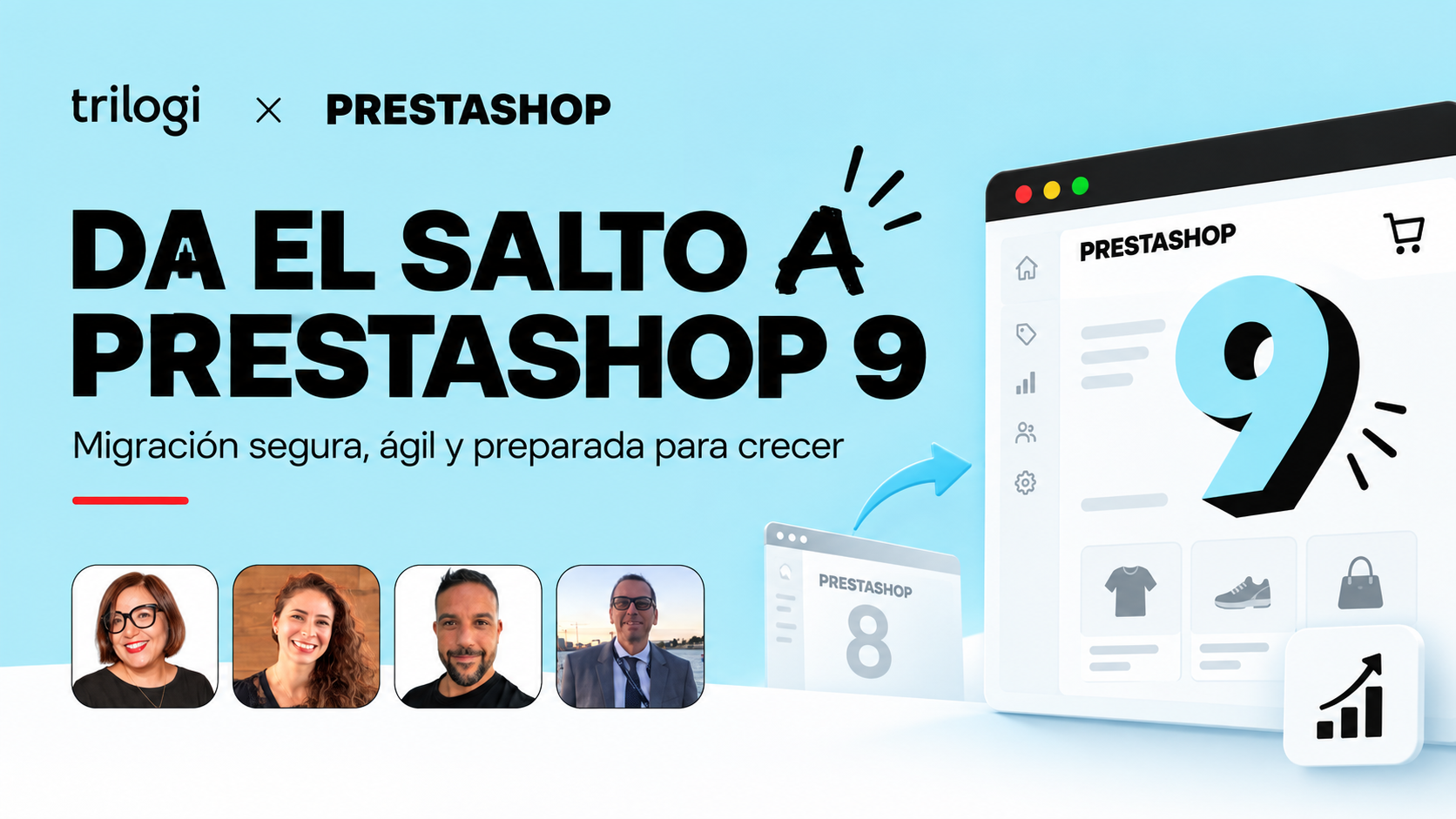
That’s exactly what we discussed in our webinar “Make the Leap to PrestaShop 9: A Secure, Agile, and Scalable Migration, ” organized in partnership with PrestaShop and featuring Neovideo Digital, one of the e-commerce companies that Trilogi has supported in its transition to PrestaShop 9.
In this article, we summarize the main conclusions. And if you'd like to know all the details, you can watch the full session in the following video on our YouTube channel.
Participants in the session include Ivy Espinosa, PrestaShop's Country Manager for Iberia; Edilia Peña, PrestaShop's Product Marketing Manager; Jaume Mallén, Trilogi's CTO; and Albert Renú, CEO of Neovideo Digital.
What's new in PrestaShop 9?
PrestaShop 9 represents a major evolution of the platform, especially from a technological standpoint.
Version 9.1 is built on Symfony 6.4 LTS and supports PHP 8.5, providing a more modern, maintainable architecture that is ready to continue evolving. The goal is to gradually reduce legacy code and facilitate more reliable development and customization.
But the change isn't limited to the back end.

Architecture Designed for the Years Ahead
Updating the platform allows you to work in a modern technological environment and makes it easier for modules, developments, and integrations to evolve alongside the PrestaShop ecosystem itself.
This is particularly important for stores that have been in operation for years and have gradually accumulated modules, customizations, and specific developments.
In fact, when migrating, one of the first steps should be to ask yourself:
Is everything currently in my PrestaShop still necessary, and does it make sense to transfer it to the new version?
The answer isn't always yes.
Hummingbird 2.0: A New Foundation for the Front End
Another new feature is Hummingbird 2.0, the new theme designed to offer a more modern and optimized experience on both mobile and desktop.
Its goals include making customization easier, improving the user experience, and developing a structure that is better optimized for SEO and accessibility.
And this point is important: a version upgrade can also be an opportunity to rethink aspects of e-commerce that haven't been reviewed in years.
Architecture, navigation, product pages, search, filters, checkout, and mobile experience can all be analyzed within the same project.
More Control Over SEO in PrestaShop 9
One of the main concerns when considering a migration is logical:
Will I lose the SEO rankings I've built up over the years?
PrestaShop 9 introduces improvements to URL management, particularly for multilingual projects, providing greater flexibility in SEO configuration.
However, a new version alone does not guarantee a successful SEO migration.
The following must be analyzed beforehand:
- Current and future URLs.
- 301 redirects.
- Discontinued products.
- Categories.
- positioned content.
- internal link.
- metadata.
- indexing.
- Performance and Core Web Vitals.
During the webinar, Jaume Mallén, Trilogi’s CTO, gave a specific example of what to do with products that are discontinued or URLs that change during migration: these decisions must be part of the project to avoid losing organic visibility.
Security: Another Reason Not to Stay on Older Versions Indefinitely
Keeping an outdated version for too long also means working with an ecosystem of modules, themes, and components that may no longer be actively developed.
PrestaShop 9.1 includes more restrictive security settings and improvements designed to reduce exposure to vulnerabilities.
For this reason, the decision to upgrade should not be analyzed solely from the perspective of new features.
It should also be considered from the perspective of maintenance, security, and the technological sustainability of e-commerce in the medium term.
A New Admin API to Connect PrestaShop to the Business Ecosystem
ERP, CRM, PIM, logistics systems, pricing tools, marketplaces…
For many e-commerce businesses, PrestaShop doesn't operate in isolation.
PrestaShop 9 includes a new Admin API, designed as a new layer to connect the platform with business tools and continue to progressively modernize its integration architecture.
This aspect is particularly important in B2B projects or in companies where the synchronization of customers, product catalogs, prices, inventory, and orders is critical.
PrestaShop 9.2: The Checkout Process Is Evolving, Too
During the webinar, PrestaShop provided a preview of some of the features planned for PrestaShop 9.2.
One of the most notable features is the new One-Page Checkout, designed to consolidate the checkout process onto a single page and reduce unnecessary steps before completing an order.
Improvements related to additional fields and new AI-related features were also announced.
Beyond each specific feature, the message is clear: PrestaShop 9 is the foundation upon which the platform will continue to evolve.
So, when should I migrate to PrestaShop 9?
Not all e-commerce sites need to update at exactly the same time.
In fact, during the webinar, we posed a fundamental question:
Are your modules, theme, and customizations compatible with PrestaShop 9?
That compatibility analysis helps determine the best time to perform the update.
At Trilogi, for example, we don't necessarily plan for an immediate migration in recent projects that run on PrestaShop 8.
The situation is different for projects that are still using PrestaShop 1.6 or 1.7, especially when they have been accumulating code, modules, and customizations for years.
And here's another important point.
Migrating doesn't always mean updating the existing installation
In some projects, it may make sense to upgrade the current platform.
In other cases, it is more efficient to set up a fresh installation of PrestaShop 9 and migrate the necessary data.
Why?
Because an audit can uncover legacy systems, custom modules created by previous vendors, unnecessary data, or poor practices that have accumulated over the years.
Carrying all that legacy over to the new version could mean bringing the same problems along with it.
During the webinar, we explained that, when the analysis warrants it, starting with a clean version can reduce complexity and prevent problems down the line.
How We Approach a Migration to PrestaShop 9 at Trilogi
A migration should be approached as a comprehensive project rather than a simple technical update.
Our methodology includes:
Technical and functional audit → release strategy → review of modules and customizations → architecture → data migration → integrations → testing → performance → SEO continuity → deployment and monitoring.
These are the ten main components that make up our migration methodology.
The goal is to identify the risks, dependencies, and opportunities associated with each project before getting started.
This is especially true when there are integrations with ERP systems, in-house developments, or business processes that depend directly on e-commerce.
Neovideo Digital: A Real-World Example of Migration to PrestaShop 9
During the webinar , we were also joined by Albert Renú, CEO of Neovideo Digital, a B2B e-commerce company specializing in professional audiovisual technology.
Neovideo started with PrestaShop 1.7.8 and needed to continue evolving its platform.
In this case, the website also features a critical integration with SAP: product information, prices, customer data, and inventory are synced to PrestaShop, while online orders are sent back to the ERP system.
This helps us understand why a migration can go far beyond the front end.
If inventory, orders, or customer data rely on an ERP system, integration must be part of the analysis from the very beginning.
For Neovideo, there was also another goal: to enable its distributors to locate products, check availability, and make purchases as quickly as possible—even from their mobile devices and outside of business hours.
It is a good example of how a technology migration can also be leveraged to improve the business experience.
How long does a migration to PrestaShop 9 take?
There is no single answer.
It depends primarily on the source version, existing customizations, the volume of data, the design, modules, integrations, and dependencies on third-party systems.
As mentioned during the webinar, a simple project can take about a month and a half to two months, while more complex projects or those with dependencies can take up to four to six months. A standard project typically takes about three months.
Therefore, before setting a fixed timeline, it is essential to analyze the project.
Are you thinking about migrating your e-commerce site to PrestaShop 9?
If you are currently using PrestaShop 1.6, 1.7, 8, or a highly customized installation, your first step should not be to start the migration right away.
You should analyze what you currently have and define what your next platform should look like.
At Trilogi, we are PrestaShop Experts with the highest level of certification, and we support e-commerce projects from the initial audit through migration, integrations, ongoing SEO, and the platform’s future development. The methodology presented in the webinar covers everything from the technical audit to deployment and monitoring.
Would you like to know what migrating your PrestaShop would entail?
We analyze your project—including its current version, modules, custom developments, and integrations—and help you define the most appropriate migration strategy.
Yes, but the procedure will depend on the project's current status. In certain stores, it may be more practical to set up a clean installation and migrate the data later than to try to move the entire existing installation.
There should be no loss simply due to the migration itself if there is a proper SEO continuity strategy in place. It is essential to review URLs, redirects, categories, products, content, and indexing before the launch.
It will depend on its compatibility with PrestaShop 9. This is one of the issues that should be analyzed during the preliminary audit.
Yes, although it is necessary to review each integration and its compatibility. In some cases, connectors or specific developments need to be adapted.
It depends on the scope. During the webinar, an approximate range of 5,000 to 12,000 euros was provided as a reference for migration projects recently analyzed by Trilogi, although design, integrations, development, or external dependencies can significantly affect the budget.